

Art
3 minutes
Painting a Night Sky in Acrylics Step-by-Step
A beginner's guide to creating stunning acrylic night skies
View Infographic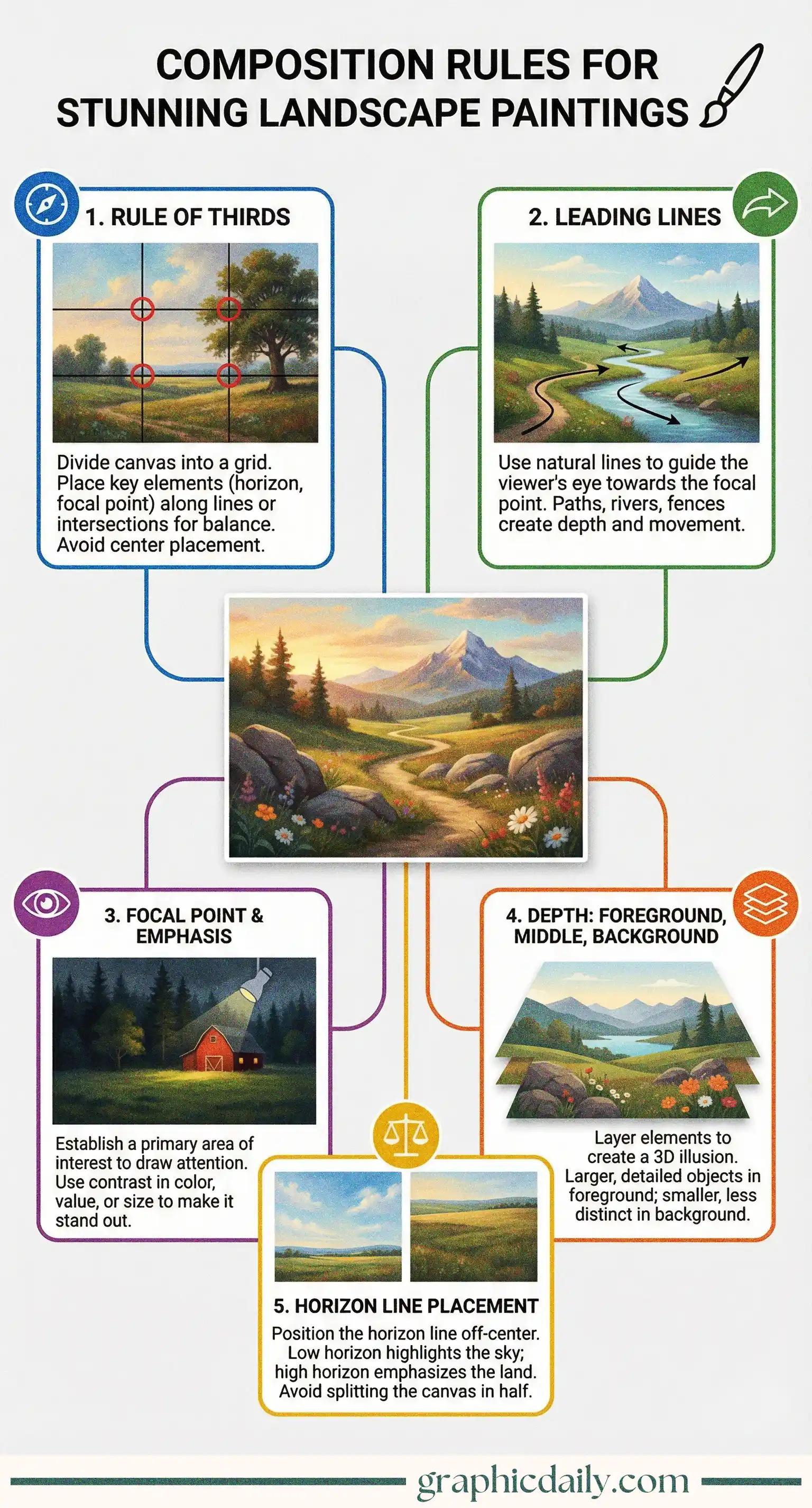
Ever stared at a landscape painting that just grabbed you, and wondered what made it so mesmerizing? I spent some time digging into this because honestly, I wanted to understand the magic behind those stunning vistas that seem to pull you right into the canvas. Turns out, it's not just talent—there's some fascinating structure beneath the beauty.
The infographic above breaks down five crucial rules that professional artists swear by, and I've got to say, once you see them, you can't unsee them. The Rule of Thirds might sound technical, but it's actually pretty intuitive: imagine slicing your canvas into nine equal sections with a tic-tac-toe grid, then placing your horizon or focal elements along those lines rather than dead center. This off-kilter placement creates visual tension that keeps eyes moving across the painting rather than getting stuck in the middle—pretty clever, right?
Leading lines work like invisible paths guiding viewers exactly where you want them to look. A meandering river or weathered fence posts become your secret weapon for creating depth and movement.
Here's where things get really interesting. Depth isn't just about making stuff smaller in the background—though atmospheric perspective (those cooler, hazier distant tones) definitely plays a role, according to traditional art theory I found while researching this. You're literally stacking three distinct layers: bold foreground details, transitional middle ground, and that dreamy distant background. It's like building a theatrical stage set! 🎨
And that horizon line? Its placement is pivotal. Drop it low to showcase an explosive sunset sky. Push it high to emphasize rolling meadows or rugged terrain below. Just whatever you do, don't plop it dead center—that's the quickest route to a snooze-fest composition.
The focal point ties everything together, demanding attention through contrast, vibrant color, or sheer size. Think of that crimson barn our infographic shows against moody forest shadows—impossible to ignore.
These aren't commandments etched in stone, though. Once you grasp them, breaking the rules intentionally becomes your artistic superpower.
Sources & Further Reading:
A beginner's guide to creating stunning acrylic night skies
View Infographic
Creating stunning minimalist art in Procreate with simple tools
View Infographic